
What business problems can custom software development solve?
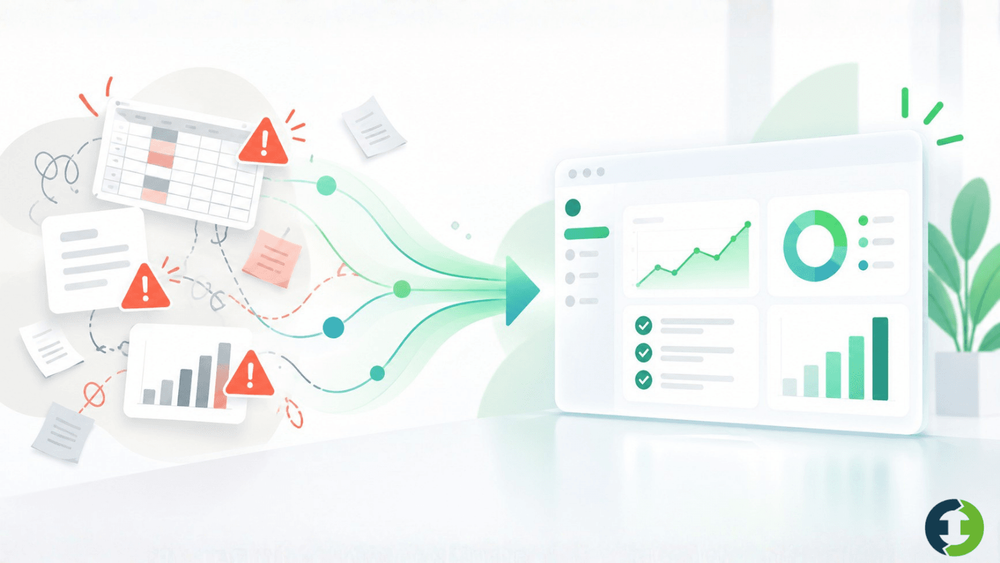
Custom software development becomes valuable when existing tools, manual processes, and disconnected systems begin to limit business growth. A tailored solution can automate workflows, connect data sources, improve transparency, and support more reliable decision making. It also allows security, scalability, and quality requirements to be built into the system from the start. The result is software that adapts to the company’s processes and creates measurable long-term business value.
Every growing company eventually reaches a point where its existing systems, endless Excel spreadsheets, manual processes and off-the-shelf solutions can no longer keep up with its needs. Instead of supporting growth, they begin to slow the company down. Yet many companies still think of custom software development as an investment that necessarily costs hundreds of millions.
A well-designed custom software solution does much more than add extra features to everyday operations. It connects processes, reduces the burden of manual administrative work, makes data more transparent and reflects the way the company actually operates. The business should not have to adapt to the software. The software should support the business logic.
When there is too much manual work and too many workarounds
One of the clearest signs that a company has outgrown its systems is the growing number of manual steps. Data is copied from one platform to another, spreadsheets circulate by email, and parallel records are maintained. Statuses are updated manually, and there may still be a post-it note attached to the side of a monitor. Each of these may seem insignificant on its own, but together they can consume days of work every month and create plenty of opportunities for error.
Custom software development in this case means more than simply automating individual tasks. The real objective is to build the logic of the process into the system itself. In a sales, customer management or administrative process, the software can automatically record data, assign statuses and forward information to the right place. It also makes that information easy to retrieve later. Employees can then spend less time on administration and more time on activities that create real value, such as customer relationships, decision making, sales and development.
When off-the-shelf software no longer fits
Off-the-shelf software can often be an excellent starting point. It works well for standard problems, common processes and situations where rapid implementation is important. The challenge begins when the way a company operates becomes more complex than the system can support.
A standard solution rarely follows every business process, approval workflow, data connection or industry-specific requirement that makes a particular company work. At that point, companies usually have two options. They can either adapt their processes to the limitations of the software or build a system around the way the business actually operates.
Custom software development becomes particularly valuable when the goal is not simply to introduce another tool, but to create a sustainable system that supports real business needs.
When systems do not communicate with each other
In many companies, the problem is not a lack of software. In fact, the opposite is often true. There may be an ERP system, CRM, invoicing software, reporting tools, internal databases, project management platforms, several Excel files and even isolated AI solutions.
Problems arise when these systems are not aligned and data does not flow properly between them. The result is familiar: the same information has to be entered twice, decisions are delayed and no one can say with complete confidence which data is up to date.
A well-designed custom software solution can bridge the gaps between isolated systems. API integration, data connections, shared interfaces and automatic synchronisation can eliminate the points where manual work and uncertainty currently occur. This is particularly valuable in processes that span several systems, such as sales, logistics, customer management, financial administration or manufacturing.
When reliable data is missing from decision making
Most companies generate large amounts of data, but this information often remains scattered across separate systems and stored in formats that are difficult to access. The data exists, but it cannot easily be turned into data-driven decision support.
Custom development can address this problem as well. The system does not simply store information, but gives it structure. The required fields, statuses, permissions, search functions, reports and business rules can all be defined in advance.
This ensures that management decisions are based on reliable information rather than intuition. This becomes especially valuable when operations involve several stakeholders, locations, customer groups or product categories.
When quality and security become business risks
For enterprise software, operational reliability, data protection and quality are not merely technical considerations. If a system processes incorrect data, grants inappropriate permissions, responds slowly, cannot be audited or fails to scale, the consequences have a direct business cost.
One of the advantages of business process tailored software is that these requirements can be built into the system from the design stage. This may include access control, audit logging, data security rules, GDPR compliance, performance requirements and a testing strategy.
The real question behind custom software development
Custom software development makes sense when it solves specific business problems. A good solution does not begin with technology, but with understanding how the organisation works.
Which processes need to be simplified? Where is information lost? Where does unnecessary administration occur? Where does decision making slow down? Which systems need to be connected? What needs to become measurable?
These questions form the foundation for a custom software solution that does more than function correctly. It can create measurable and lasting business value.
- AI-supported custom software development